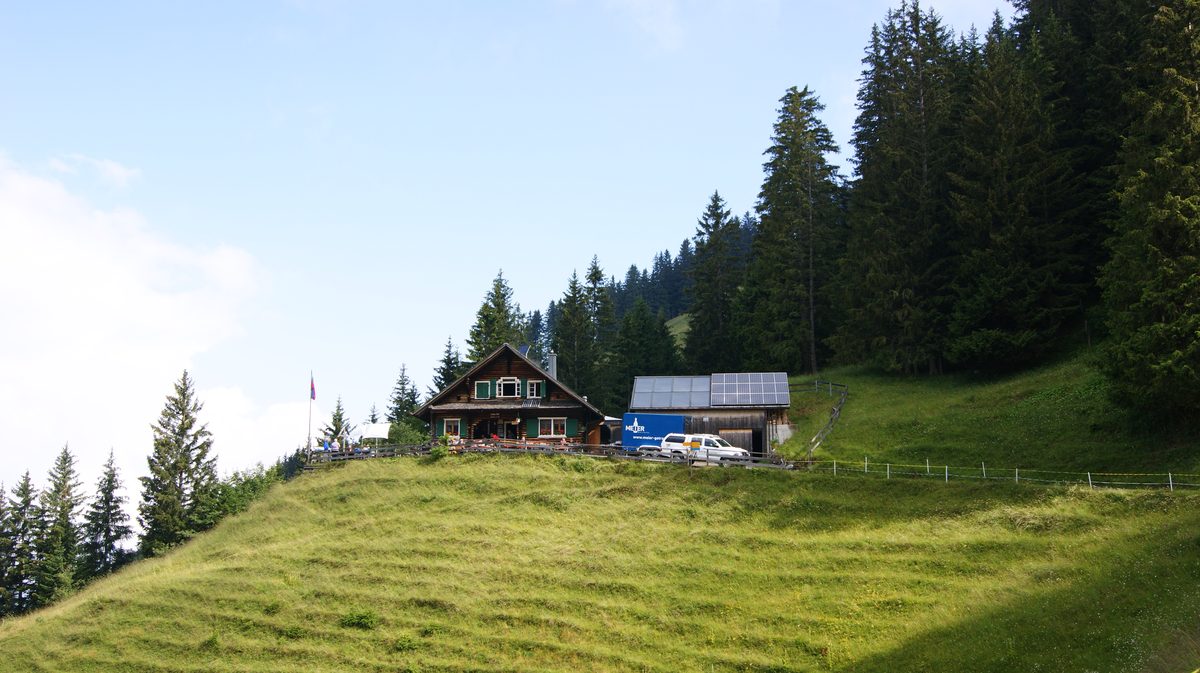
In the huts of the German, Austrian and South Tyrolean Alpine clubs, every bed comes with one rule: you sleep in a hut sleeping bag, a thin sheet bag that goes between you and the blankets. The Italian Alpine Club (CAI) makes the same rule for its rifugi. Most surprises on a first hut night are like that: written down somewhere, just not where a first-timer looks.
First, find out who runs the hut
Most huts belong to an Alpine club, or to one of its local sections, and the club's rules apply. In Germany and Austria that's the DAV and ÖAV hut regulations, which the South Tyrol club (AVS) shares. Switzerland has the SAC, Liechtenstein the LAV, France the FFCAM and Italy the CAI. Some huts are private. On the Tour du Mont Blanc, the huts and gîtes book through their own association's platform.
Members pay less. Under the DAV and ÖAV rules, non-members pay at least €12 more per night in a club's basic huts. Members of clubs with a reciprocal agreement get the member price, but only with a valid membership card. If you plan several hut nights, ask your own club whether it has such an agreement.
Book online, and early for July and August
- Hut Reservation (hut-reservation.org) books more than 500 huts across the Alps. The DAV, ÖAV, SAC and AVS run it together, and it replaced alpsonline.org at the end of 2024. Not every hut takes part. Those that don't, book by phone or email.
- Mon Tour du Mont-Blanc (montourdumontblanc.com) books the huts on the TMB. Bookings for the next summer open in the autumn; check the date on the platform. Our French Alps post covers how to plan the nights around it.
- Prenota Rifugi (prenotarifugi.cai.it) is the CAI's booking service for Italian rifugi.
- French club huts (FFCAM) each take bookings on their own refuge page at ffcam.fr.
Under the DAV and ÖAV rules, a hut can only take advance bookings for 90% of its beds. Don't count on the rest: the rules keep priority for injured people who can't get down and for mountain rescue teams on duty.
Check that your hut is open at all. The Refuge de la Croix du Bonhomme on the TMB, for example, is currently closed for rebuilding; check its page.
Read the cancellation rule before you pay
Every hut sets its own terms, so read them on the booking page. Three examples show the range:
- SAC huts: cancel, change or move a booking free until 18:00 (6 pm), two days before your first night. After that the hut can charge up to the full price of what you booked, half board included. The SAC has decided on a CHF 10 reservation fee per guest per night for its staffed huts, from January 1, 2027 at the earliest. It goes on your card when you book, counts toward your bill when you arrive, and isn't refunded if you cancel.
- The TMB platform: you pay a deposit. Cancel more than 30 days ahead and you get 80% of it back; within 30 days, nothing, unless the platform's cancellation insurance covers your reason.
- DAV and ÖAV huts: the hut can take a deposit and charge a cancellation fee. The amount is the hut's, so ask the hut.
If your plans change, cancel. The SAC asks you to cancel whenever a tour falls through or your group gets smaller.
What a night costs (as of October 2026)
- SAC huts: a bed costs CHF 25 to 50 for an adult; with half board (dinner, bed and breakfast), CHF 70 to 100. Every staffed SAC hut offers half board.
- TMB huts: €65 to €95 a night with half board in a dormitory.
- CAI rifugi: the CAI sets the maximum price of a dormitory bed each year: €30 to €39 for non-members in 2026, by hut category, and €24 to €31.20 for members. Members get at least 20% off half board.
- DAV and ÖAV huts: in their basic huts, a member's dormitory bed costs at most €15.
Half board is usually the way to eat. The DAV says the evening is mostly a multi-course half board, and ordering à la carte late is often no longer possible. In German and Austrian club huts, the hut can't make half board a condition of your booking, though. Look for the Bergsteigeressen there: a mountaineer's meal, at least one of them vegetarian, that costs club members no more than €11.
Bringing your own food is limited. In DAV and ÖAV huts it's only allowed for members, in a self-catering room, for €5 a night. In CAI rifugi, non-members pay a €3 contribution to eat their own food.
What to pack
- A hut sleeping bag (liner). Silk or cotton, as the SAC puts it. It's compulsory in DAV, ÖAV and CAI huts, and several French club huts ask for one too. Forgot it? Most huts sell or rent one, for example for €5 at a CAI rifugio.
- Earplugs and a towel. The TMB platform's advice for dormitories.
- A headlamp. On the TMB kit list, and the Pfälzerhütte's winter room asks you to bring one.
- Cash. See below.
Don't expect a hotel. The DAV lists what's missing: no duvets, usually no showers, and strangers in your room. You sleep in a dormitory (Lager) or, for a little more, in a multi-bed room.
Bring cash
Card payment is spreading, but don't rely on it. The SAC says many of its huts now take cards and still tells you to carry enough cash. The Pfälzerhütte in Liechtenstein takes cash only (Swiss francs, or euros at the day's rate). Some CAI rifugi have a card terminal; the hut's page says which.
The evening
On the TMB, dinner is at about 18:30 or 19:00 (6:30 or 7 pm), and the platform asks you to arrive at least an hour before. In German and Austrian club huts, you sign the hut book when you arrive. Add your next destination and your phone number; the rules recommend it, so rescuers know where to look.
Mountain boots stay out of the bedrooms, and so does food. Under the DAV and ÖAV rules, you don't eat or cook in the sleeping areas, and you don't use candles or stoves there. Smoking is banned everywhere in the hut, and no music plays, except through headphones for the weather forecast.
Quiet hours start at 22:00 (10 pm). That's the SAC's time, the DAV and ÖAV rule (22:00 to 06:00, sometimes later by agreement, never after midnight), and when the TMB huts turn out the lights. If you leave before dawn, pack the night before. The DAV and ÖAV rules ask early starters not to wake the room.
Winter rooms
When a hut closes for the season, a part of it often stays open: the winter room. It's unstaffed, with beds and blankets, sometimes a stove, and you pay on trust. The Pfälzerhütte's winter room, the Adlerhorst, has 21 bunks, a wood stove and a cooker, and costs CHF 20 a night, paid into the cash box or by bank transfer. Our Liechtenstein post has the hut seasons there. Some Austrian and German winter rooms are locked and open only with the clubs' AV key, which members borrow from their section. The SAC says some of its huts have closed their winter rooms. Check before you go, and carry your own food: a winter room sells nothing.
A first hut to try
The Pfälzerhütte (2,108 m / 6,916 ft) stands on the Fürstin-Gina-Weg above Malbun in Liechtenstein, a waymarked loop you start from a bus stop. Half board costs CHF 68 for members of an Alpine club and CHF 75 for everyone else (as of October 2026), with a vegetarian three-course dinner. It opens for the summer in early June and books through Hut Reservation. If one night goes well, the next step is a hut-to-hut route: the Tour du Mont Blanc's huts all book through one platform.
Book the first hut for a weeknight: the SAC says huts fill up mostly at weekends and in high season. Then pack the liner first.
Last checked: October 2026