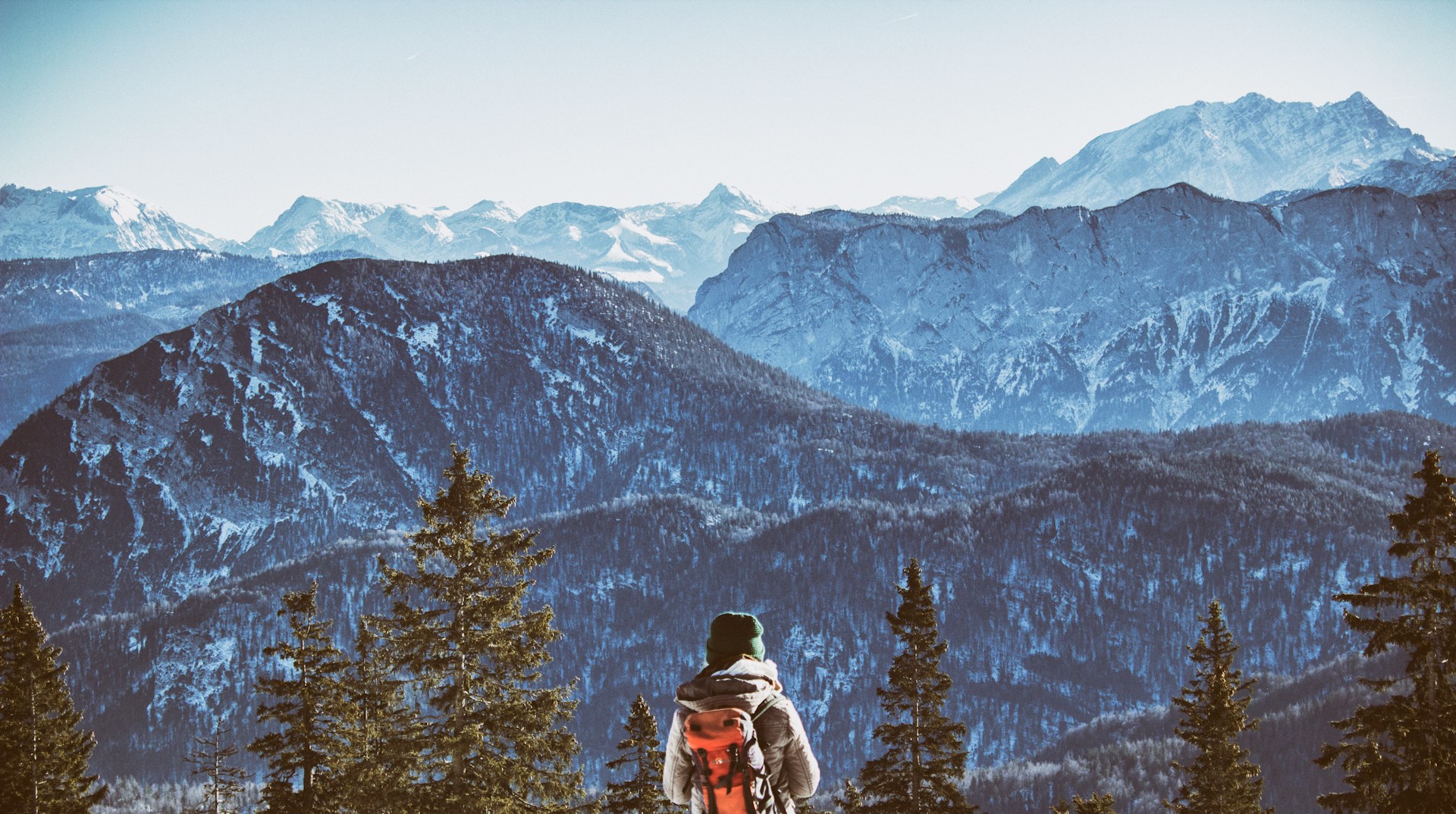
Germany's share of the Alps is a narrow strip along the Austrian border, and its two best-known corners sit at opposite ends of it. Garmisch-Partenkirchen, below the Zugspitze (2,962 m, 9,718 ft), is 1 hour 27 minutes from Munich by regional train. Berchtesgaden, above the Königssee, is close to three hours. The Deutschlandticket, €63 a month (as of October 2026), covers both train journeys and the local buses. It doesn't cover the lifts or the boats.
The times below are from the October 2026 timetable for a weekday. Check them in the DB app before you go, because they shift at each timetable change in December.
Day 1: Garmisch-Partenkirchen, the Zugspitze and the Eibsee
07:28, Munich Hbf. The RB6 to Garmisch-Partenkirchen leaves hourly at :28 and arrives at 08:55. The Zugspitze cog railway leaves from its own station next to the main one.
09:15, cog railway. The train climbs to the Zugspitzplatt in 75 minutes, and the Gletscherbahn cable car takes you the last 4 minutes to the summit. The Ticket Zugspitze costs €78 for adults (as of October 2026) and covers one way up and one way down. It's also valid for the operator's round trip: up by cog railway and Gletscherbahn, down by the cable car to the Eibsee. The Deutschlandticket is valid on the cog railway only between Garmisch and Grainau, and gets no discount on the mountain ticket. A DB return ticket, the Bayern-Ticket or an Interrail pass does get a discount at the ticket office.
Around 10:40, the summit. The border with Austria runs over the top. Spend as long as you like, but note the last trains up: the cog railway's last ascent leaves Garmisch at 14:15.
Early afternoon, down to the Eibsee. The Seilbahn Zugspitze drops to the lake in 10 minutes, at least every half hour. Opening hours are 08:30 to 16:45 from September to June and 08:00 to 17:45 in July and August.
Afternoon, the Eibsee loop. The path starts at the Eibsee-Hotel, near the cable car station: 6.8 km (4.2 mi), 123 m (404 ft) of climbing, about 1 hour 55. It follows the shore in places and climbs to benches above it. The lake formed when a rockfall created the basin at the end of the last ice age, and the Zugspitze rises almost straight up behind it. Grainau's tourist office rates it very easy and suitable for strollers.
From the Eibsee back. Take the regional bus back to Garmisch (covered by the Deutschlandticket). It leaves hourly at about :10 and takes 30 minutes. If you'd rather take the cog railway, ask at the ticket office whether your mountain ticket covers it. Trains to Munich leave Garmisch hourly at about :05 and take 1 hour 20.
If the summit is in cloud, check the webcams and the summit forecast on zugspitze.de before you buy, and walk the Partnachklamm instead. Bus 1 or 2 from the station runs to the Olympic ski stadium, where the gorge path starts. The gorge is 702 m (2,303 ft) long and up to 80 m (262 ft) deep, with tunnels, galleries and wire handrails. The loop back over Graseck is 6.2 km (3.9 mi), 258 m (846 ft) up and down, about 2 hours. Entry is €10 for adults (as of October 2026). The gorge opens 08:00 to 20:00 from June to September and 08:00 to 18:00 the rest of the year. It closes at short notice when it isn't safe.
Day 2: Berchtesgaden and the Königssee
06:43, Munich Hbf. Take the RE5 to Freilassing and change there for Berchtesgaden, arriving at 09:38. The 05:49 arrives an hour earlier, which matters in summer (see below). The Railjet via Salzburg takes about as long, but the Deutschlandticket isn't valid on it.
09:45, bus to the lake. Buses 840, 841 and 843 run from Berchtesgaden station to Königssee in about 10 minutes, several times an hour. The boat landing is a 5-minute walk from the stop.
Around 10:00, the boats. There's no road or footpath along the Königssee's shore, so the electric boats, running since 1909, are the only way across. St. Bartholomä, with its pilgrimage church below the Watzmann's east face, is 35 minutes away. A return ticket costs €23.40 (as of October 2026). Boats leave at least every 30 minutes, and every 10 minutes on fine days in the holidays. On the way, the boatman plays a trumpet against the rock walls for the echo. Allow about 90 minutes for the round trip, plus your time on the peninsula. There are no toilets on board.
From Easter to mid-October, on to Salet. The boats continue to Salet at the far end, 50 minutes to an hour from the start. A level path leads past the Saletalm to the Obersee in about 15 minutes. The out-and-back walk to its jetty is 2 km (1.2 mi), 13 m (43 ft) of climbing, about 1 hour. Across the lake, the Röthbachfall drops about 400 m (1,312 ft), Germany's highest waterfall. Allow about two hours for the boat trip there and back. The Berchtesgaden National Park guide has the trail map, plus the climb to the Watzmannhaus if you stay longer.
Afternoon, back to Munich. Trains leave Berchtesgaden hourly at :19, with a change at Freilassing, and arrive at Munich Hbf about 2 hours 50 later.
Where the plan breaks
The cog railway gives priority to passengers with a mountain ticket. On weekends and in the school holidays, the operator warns that it may not carry everyone travelling on a Deutschlandticket.
At the Königssee, expect waits from July to mid-September, on public holidays and on fine days after a spell of rain. On those days the operator advises starting before 10:00 and heading back by 14:30. On a few days a year, tickets sell out by early afternoon, both online and at the ticket office. Buying online lets you go straight to the jetty.
The Zugspitze closes completely for a few weeks of maintenance in November; check the dates on zugspitze.de. Salet isn't served after mid-October. The trip to St. Bartholomä runs all year, except on 24 December and when the lake freezes.
Berchtesgaden means close to six hours on trains for one day. If that's too much, stay a night there and add the national park walks.
Before either day, check the Zugspitze webcams or the Königssee waiting-times page the evening before, then pick the day to match the weather.
Last checked: October 2026