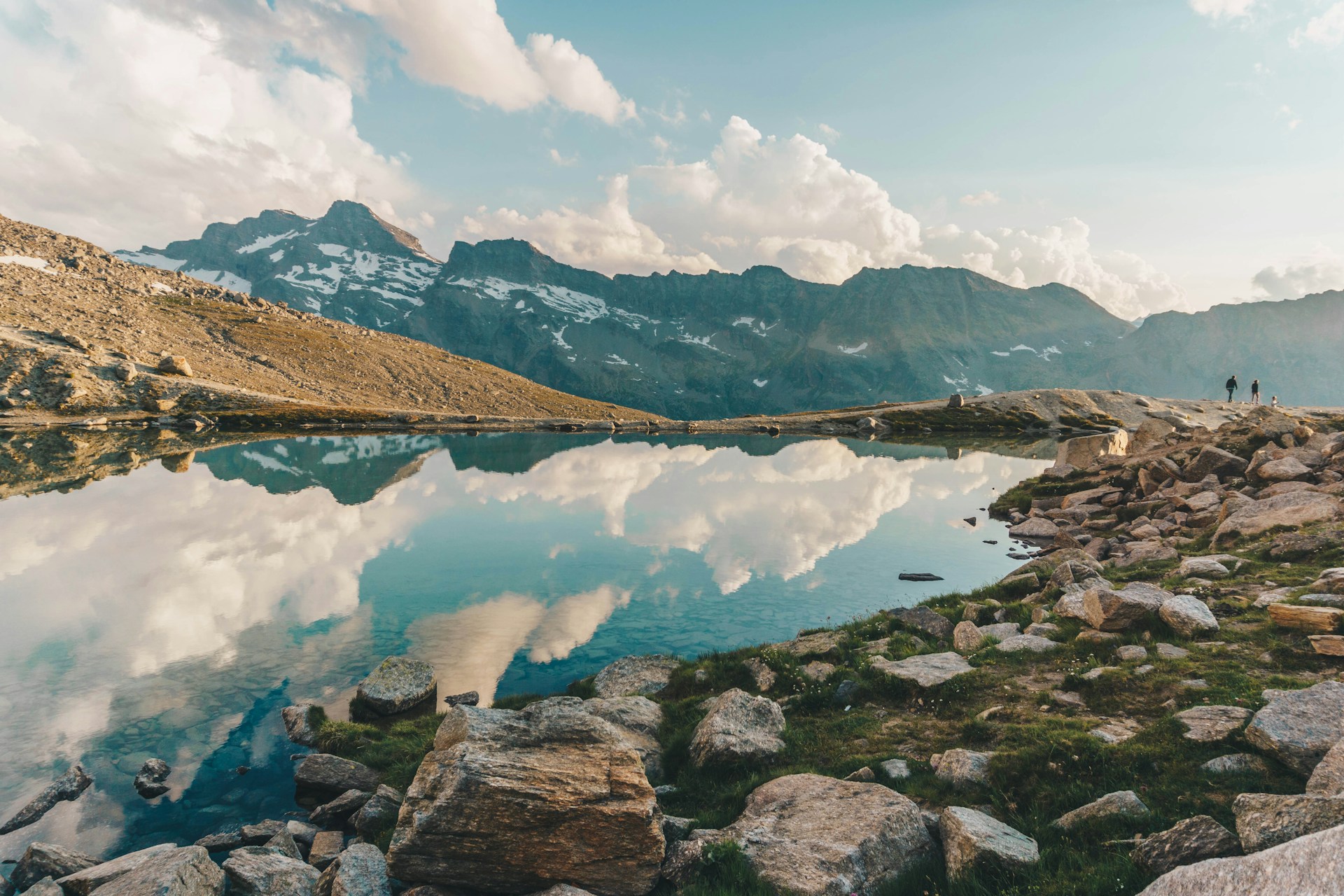
In 1945 there were 416 ibex left in the Gran Paradiso. The park, Italy's first national park, had been founded in 1922 to protect them, and the war nearly undid it. The ibex is still the park's symbol, and the path above Valnontey is one of the places to look for one. It's also a good reason to see Italy's Alps beyond the Dolomites, from the Aosta Valley in the west to the Brenta in Trentino.
Aosta, for the Romans: a day without hiking
Aosta was founded as Augusta Praetoria in 25 BC. Coming in from the east, you pass the Arch of Augustus and then the Porta Praetoria, the main gate in the old walls. The Roman theater's southern facade still stands 22 m (72 ft) high, with its rows of arches.
One ticket, Aosta Archeologica, covers the theater, the cryptoporticus (an underground gallery under the old forum), the early Christian church of San Lorenzo, the regional archaeological museum and the MegaMuseo. It costs €10 (as of October 2026), is free under 18 and stays valid for six months. From April to September the theater is open daily 09:00 to 19:00 (7 pm), with last entry 30 minutes before closing. It's a town walk, so keep it for the day you arrive or a day of bad weather.
Gran Paradiso, for the ibex: Valnontey and the Rifugio Sella
The park started as a royal hunting reserve in 1856, which saved the ibex from dying out. It became Italy's first national park on 3 December 1922. On the Aosta Valley side, the base is Cogne, about 35 minutes' drive from Aosta. Svap runs the buses; check svap.it for the timetable. Dogs are allowed only on a leash, on the valley floor and, in summer, on a list of trails the park publishes on pngp.it.
From the car park at Valnontey (1,666 m, 5,466 ft), the Aosta Valley's tourism board describes the path to the Rifugio Vittorio Sella: the Alta Via 2 or path 18, across a bridge, past the Paradisia garden and into the forest. It's 900 m (2,953 ft) of ascent and about 2 hours 30 to the hut at 2,588 m (8,491 ft). Ibex, chamois and marmots may be seen along the way; that's a chance, not a promise. The hut is open from 1 June to 20 September and has 140 beds, so you can stay up there and look again in the evening.
Paradisia, the park's alpine garden at about 1,700 m (5,577 ft), holds more than 1,000 species. It's open from late May to mid-September; admission is €5 (as of October 2026).
The Brenta Dolomites, from Trento: a hut walk from the Grostè
The Brenta is one of the nine systems of the Dolomites World Heritage Site. It lies west of the better-known groups, above Madonna di Campiglio. Trento is the city stop on the way: our Trento guide covers the cathedral square and the Castello del Buonconsiglio. Trentino Trasporti's line B201 runs directly from Trento to Madonna di Campiglio every day.
The Grostè gondola above Madonna di Campiglio goes up in two sections. It runs from late June to mid-September, 08:30 to 17:00, opening at 08:00 in August. A return ticket for both sections costs €30, or €35 from late July to the end of August (as of October 2026). The lifts reach the Rifugio Graffer (2,263 m, 7,425 ft).
From the Graffer, the Trentino alpine club (SAT) describes a traverse on paths 331 and 316 to the Rifugio Tuckett e Sella (2,272 m, 7,454 ft). It's 4.25 km (2.6 mi), about 244 m (801 ft) up and 212 m (696 ft) down, 1 hour 35 each way, graded E: a mountain path, not a via ferrata. Both huts open from 20 June to 20 September. The Via delle Bocchette starts from the Tuckett; that one is a via ferrata, for climbers with the gear.
Two trips, not one
The Aosta Valley and the Brenta are about 400 km (249 mi) apart, about four and a half hours by car without stops. Do the west in one trip, Aosta and Cogne, and the Brenta in another, or give a whole day to the drive. The high parts work from about June to mid-September only: that's when the Sella and Tuckett huts open and the Grostè lifts run. Outside it, Aosta and Trento are the cities to see.
Getting there
Aosta has direct trains from Turin, Porta Nuova and Porta Susa, in under two hours. Check the Turin–Aosta timetable on lovevda.it before you go; works on the line can mean replacement buses. Trento is on the Brenner railway. Mont Blanc and Courmayeur are part of the Tour du Mont Blanc, in our French Alps post.
Last checked: October 2026